
The Beginning (Re-Post)
** originally published January 6th, 2025 **
Welcome
Hello friends. The purpose of this e-mail is to inform you that I’ve automatically subscribed you (sorry) to a small newsletter that I’m planning to send around from time-to-time.
To be clear, the goal here isn’t to grow a newsletter. My plan is to discuss my personal investing journey and thoughts on markets more generally with a select group of individuals. I find discussing business/investing/markets fun, and I find it even more fun to do so with friends and intellectual peers. I hope that this effort leads to some interesting conversations, and that I’ll learn things from some of you along the way. This is simply part of my attempt to “learn in public.”
On that note, this will be a sort of public investing journal of mine. I plan to share what I own in my personal account, what investments I’m making, and what my performance has been. I funded a new account in December of 2024 specifically for the purposes of sharing all related portfolio activity.
I also plan to share higher-level thoughts on markets, investing, news, etc. However, this will all be anchored by a commitment to publicly sharing my investment decisions.
To quote Nassim Taleb: “Don’t tell me what you think, tell me what you have in your portfolio.”
If you get this e-mail and are uninterested, feel free to unsubscribe or let me know you don’t care to be on this list. It will not bother me.
If you are interested, lower your expectations.
My Portfolio
To the fun stuff.
I’ll start by giving an overview of my portfolio as it exists on January 1st, 2025. There is no "performance" to report at this point, as the account was just created.
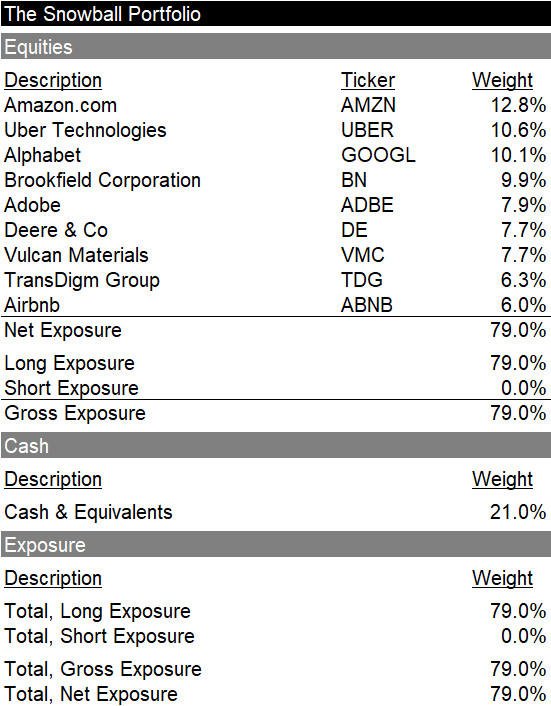
In the future, I plan to briefly cover the investment theses for many, if not all, of these investments. However, that would take more time than I’m willing to commit (or you're likely to give) to this initial message.
If you have any questions about these investments, I’m more than happy to discuss.
However, I will address why I currently have only ~80% of my capital invested. The short answer is that I believe forward expected returns are likely to be low.
Low Expected Returns. What to Do?
While it’s impossible to make predictions about what the market will do over the next year or two, the further we look out, the better we can make directional predictions about expected returns.
Long-term returns = growth in free cash flow + cash payouts (dividends and buybacks) +/- the change in the valuation multiple. When thinking about the S&P 500 Index over the next 10 years…
- We could forecast nominal GDP to grow in-line with the long-term historic average of ~4% and hold operating margins (which are elevated vs. history) flat over the period. This would result in roughly 4% FCF growth.
- We could then take the current FCF yield on the S&P 500 of ~4% as a good proxy for expected cash returns.
- So… 4% growth + 4% yield = an 8% return before factoring in any change in the index’s multiple.
- However, the S&P 500 currently trades at ~22.8x forward earnings vs. it’s long-term average of closer to ~17x. Fading the multiple from ~22.8x to 17x over 10 years would provide a ~3% return headwind, bringing our estimated 10 year return down to ~5%, well shy of the market’s long-term average of ~9%.
This is way over-simplified, but you get the point. The next 10 years are likely to be materially worse than the ~13% annualized experienced over the last 10 years.
Interestingly, Goldman’s Portfolio Strategy team recently put out a piece of research calling for 10-year returns of only 3% for the S&P 500 (!). Even worse than my 5% back-of-the envelope estimate.
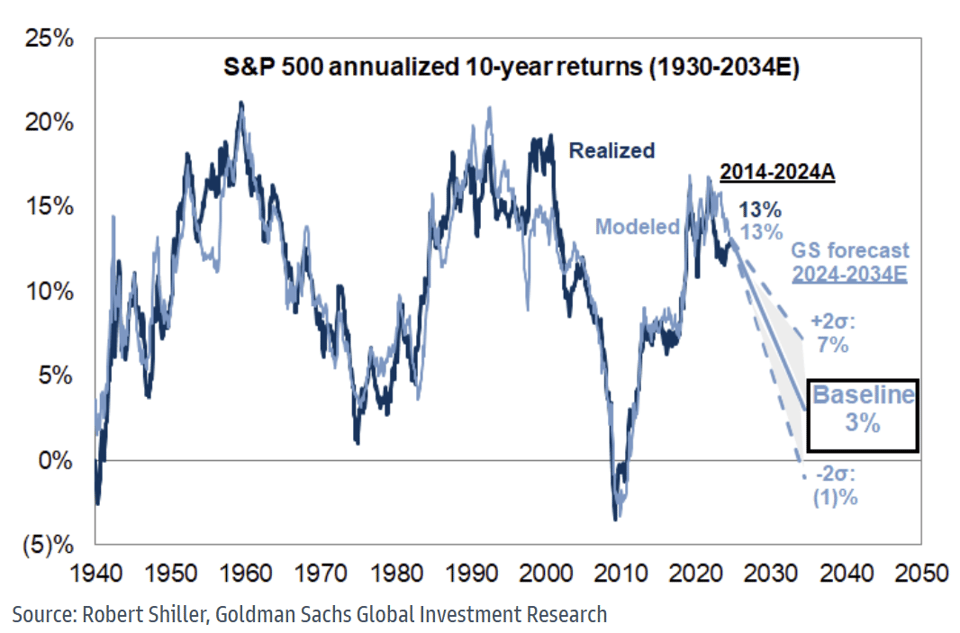
These forecasts (both mine and Goldman’s) are imprecise and quasi-foolish considering no one knows the future. However, I believe these forecasts can help inform one’s personal hurdle rate. In a normal environment (whatever that is), I try to underwrite to a 15% IRR over five years. In a low-return environment, I may be willing to be slightly more aggressive with respect to underwriting new investment ideas.
Another alternative (vs. lowering one’s hurdle rate / being more aggressive) is to simply hold more cash, waiting for forward expected returns to go up (read: stock prices to decline). While I’m willing to do this with a portion of my portfolio (20% right now), I’m uncomfortable holding much more cash than this. Over time, I expect equities to outperform cash. Holding a large cash allocation over many years will almost certainly underperform (especially considering the U.S Government’s insistence on eroding the dollar’s purchasing power). To think I’ll outperform by holding cash and then deploying it at the perfect time is quite literally market timing, something I don’t believe I have any real talent in doing.
Ultimately, holding 20% cash is temporary. I hope to put that cash to work in attractive investments soon — either due to the market selling off or by stumbling upon idiosyncratic opportunities.
5 Tenants of My Investment Philosophy
Lastly, I want to give a very brief overview of my personal investment philosophy, which informs the type of investments I plan to make. At some point I'll dive more into each of these tenants — and highlight the type of behavior these beliefs both encourage and restrain. However, for the sake of brevity, here are the tenants:
- Any asset’s intrinsic value is determined by the amount of cash that asset can return to its owners from the date of purchase onwards, discounted back to the present.
- Market quotes for assets are often significantly more volatile than the underlying intrinsic values of those assets.
- All securities simply represent a claim on an asset.
- A significant portion of all wealth has been created by a small handful of businesses that possess sustainable competitive advantages.
- It requires sustained focus to identify and deeply understand the sources of these sustainable competitive advantages.
Some of these tenants may appear straightforward and simple. That is because they are. In my opinion, successful investing is predicated on not forgetting the principles taught in Finance 101.
Looking Forward
In the future, I plan to share my views on some of the businesses I’m invested in, update you on my thoughts regarding market conditions, report my performance, comment on general news, and occasionally gripe about how inflation is underreported & the deficit is a much bigger problem than it was even 10 years ago (with no one in Washington who seems to care).
I’m not quite sure what my posting cadence will be as I’m currently test-driving this to see how valuable I find this exercise. However, thanks for (hopefully) being willing to join me in the process.