
I'm Feeling Lucky (pt. 2)
Google Remedy Ruling
Earlier this week a United States District Court Judge released his promised much-anticipated "Remedy Ruling" in United States v. Google LLC (2020) – the antitrust case the DOJ brought against Google Search. Alphabet stock is up almost ~12% since the ruling was announced, and I want to give a few thoughts on the ruling (and its impact on Google Search) below.
Background Facts & Monopoly Law
First, a few quick background facts on the case and a mini-primer on antitrust law in the US:
The original case was "bifurcated" into two parts:
- The "Liability" phase, where the Court determined Google was liable (‘guilty’ applies only in a criminal case; this was a civil matter) for illegally maintaining a monopoly in the "general search services" market and...
- The "Remedy" phase, where once Google was deemed liable, Google and the DOJ argued how this should be remedied.
This allows for it to first be determined, "did Google do something wrong?", and second, "what should we do about it?"
In the "Liability" portion of the trial, two questions are asked:
- First, does Google have a monopoly in the "defined market?"
- Typically, having over ~70% market share qualifies as a monopoly. But this immediately becomes more complicated than it first appears, because what defines a "market?" The DOJ argued that the applicable market was "general search services", and this market basically includes Google Search, Bing, Yahoo, etc. By this definition, Google has 90% market share. Google argued that the market is significantly more expansive, and that they compete with Amazon and eBay in retail, Booking and Expedia in travel, AutoTrader and CarMax in automotive, Facebook/Instagram/TikTok in a host of different categories, etc. By Google's definition, its market share would've been low enough to avoid qualifying as a monopolist.
- Second, has Google maintained or extended its monopoly by anti-competitive conduct?
- Put plainly, it isn't illegal to have a monopoly. It's illegal to have a monopoly and act anti-competitively.
Market Definition
To start, I'm including an excerpt of the first page of the ruling because I thought it was interesting how Judge Mehta framed his ruling. It's worth reading, as it affects both his proposed remedies and the legal path forward for Google.
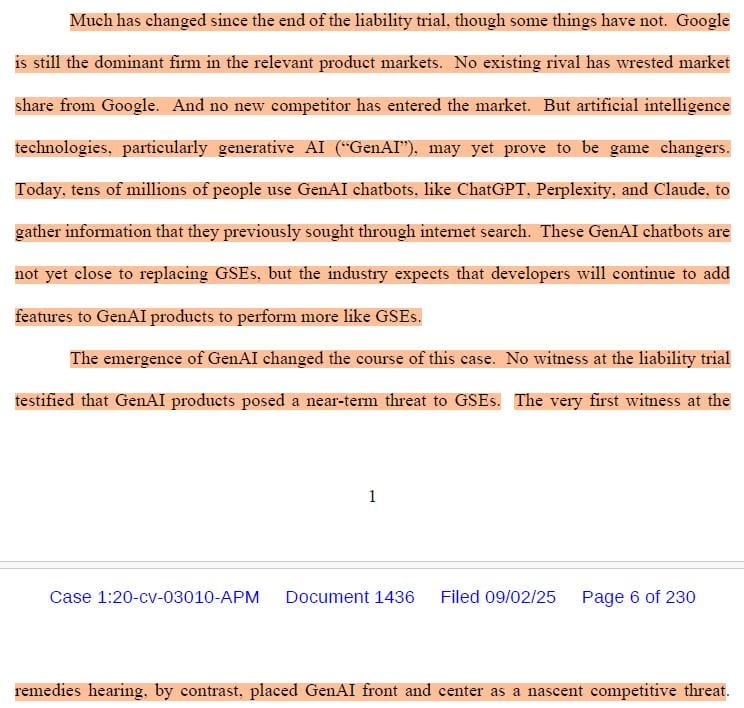
Further, the Judge later wrote:
"These remedies proceedings thus have been as much about promoting competition among GSEs as ensuring that Google’s dominance in search does not carry over into the GenAI space."
Google's blog response seizes on this admission to refocus on the "liability" phase of the trial. Rightfully so. I believe Google is now armed with a very strong chain of logic upon which to appeal the liability phase.
They'll argue "We were only liable for being a monopolist because the market was defined as 'general search services.' We disagreed with this definition at the time, but the Judge preferred the DOJ's definition. However, now, by the Judge's own admission, we are facing intense competition from GenAI, so much so that the Judge's remedies extend to non-'general search services' GenAI-related distribution deals. How can GenAI simultaneously not be a part of the defined market, but also be repeatedly mentioned by the Judge throughout his remedy ruling and directly addressed by the proposed remedies in an attempt to restore competition in the defined market?" I think this will be a very good argument from Google's perspective, and is almost certainly going to be Google's first line of attack on appeal.
The Proposed Remedies ("The 3 D's")
In my framing, there were 3 big areas of potential remedy ("3 Ds"):
- Divestiture – Google will not be forced to divest Chrome or Android. The DOJ was asking for an immediate divestiture of Chrome and a potential divestiture of Android if competition wasn't restored to the market. The Judge emphasized that divestiture is the “most drastic” form of antitrust remedy and should be “imposed only with great caution, in part because its long-term efficacy is rarely certain.” He leaned heavily on Microsoft precedent, which requires “a clearer indication of a significant causal connection” between the violation and the asset in question before ordering divestiture. He concluded that in Google’s case, that standard wasn’t met, because Google’s market power wasn’t caused by its mere ownership of Chrome or Android, and so structural relief “is a poor fit” and “wisdom counsels against adopting radical structural relief." When summarizing his high-level remedies, Judge Mehta flat out wrote that the DOJ had overreached: "Plaintiffs overreached in seeking forced divestiture of these key assets, which Google did not use to effect any illegal restraints." (My take: Big win for Google.)
- Data-Sharing – There are really two aspects to the data sharing remedies: (a) data-sharing with "qualified competitors" and (b) a search syndication component.
- Data-Sharing with Qualified Competitors - Google must give qualified competitors a one-time snapshot of its web search index at marginal cost, including unique document IDs, URL map and duplicates, first-seen and last-crawled timestamps, spam score, and device-type flags. The goal is to jump-start rivals into building their own search index that includes the "long-tail" of queries. Google will also be forced to give competitors limited sets of user-interaction data (clicks, dwell time, hovers) "periodically" (to be defined by the Court appointed Technical Committee). (My take: Another pretty big win for Google. Google will not be required to provide ongoing access to its index. And since 15% of searches a day are queries that have never been searched before... the long-tail of queries and websites will continue growing. To compete with Google, you'd need much more than a snapshot of its index. You'd need the infrastructure they've built to maintain and add to the index on an ongoing basis. As for the user-side data (clicks, etc.), Google is not required to turn over any of the underlying models (Glue/RankEmbed) or other popularity ranking algorithms (Navboost, PageRank)... just the raw data. And not continuously, just periodically.)
- Search Syndication – Google must offer organic search results syndication to Qualified Competitors (QCs) for the next 5 years on "ordinary commercial terms" (similar to the deal they have with Yahoo Japan). This includes results across Google properties (Local, Maps, Video, Images, Knowledge Panel, etc.). In Year 1, no more than 40% of queries served by a QC can be from a syndication deal with Google (so a competitor couldn't just link through to Google 100% of the time). This 40% will taper down over time. Google must also syndicate search-text ads to QCs for 5 years as well (only when a syndicated Google organic search result is also shown). However, advertisers can choose to opt out of this. (My take: Eh, not terrible. I think it's going to be hard to bootstrap off of Google's organic results. To get people to move off Google, I think you'll need a better product... not the same product. However, it would have been nice to not have Local/Maps/Knowledge Panel included, as these do provide Google with a unique advantage.)
- Distribution – In my opinion, this was the most important potential remedy. The risk to any changes to the status quo is that Apple has the power to steer highly-monetizable traffic (because the iPhone is the gateway to the online world for most wealthy individuals) and we are potentially at the cusp of a change in the search mobile landscape with the advent of GenAI. Neither of these worried me in isolation. However, I was concerned that the Judge would prohibit any payments between Google and Apple (although I thought this was an unlikely and legally fraught remedy), and that right as GenAI assistants are taking off, Apple would then be incentivized to work with anyone but Google... because Google would be the only partner who couldn't pay them for traffic. The Judge ruled that Google may not sign "exclusive" contracts, or contracts that prohibit partners from distributing rival products (including GenAI products) in any way. Google also cannot tie the Play Store to other Google apps or search default status to any Google app... and revenue sharing agreements can't be conditional on pre-installing Search, Chrome, or Assistant. All contract lengths must be capped at one year. The Judge will continue to allow payments for default status (just not "exclusive default" status). This was done to avoid blunt harm to third parties (OEMs like Apple and Samsung, Carriers like Verizon, Firefox, etc.) who rely on payments from Google. Interestingly, the Judge acknowledged that allowing the revenue payments to continue may freeze the market in Google's favor: "The court well recognizes what eschewing a payment ban may mean for competition. Due to Google’s massive financial advantage and its superior monetization, distributors will be incentivized to stick with Google because it can pay more, thus leaving in place the very forces that ‘effectively [have made] the ecosystem exceptionally resist[ant] to change.’ … Continuing payments also could blunt the effectiveness of the remedies imposed.” But he also explained why he allowed payments anyway: He said this outcome was “more palatable now” than when the liability ruling came down, because GenAI entrants are receiving billions in funding and creating new competitive pressure. That gave him “hope that Google will not simply outbid competitors for distribution if superior products emerge.” He explicitly invoked judicial caution emphasizing that courts should let markets try first rather than imposing blunt bans. "For now, Google will be permitted to pay distributors for default placement. … Still, judges must be open to clarifying and reconsidering their decrees in light of changing — or unchanging — market realities. The court is thus prepared to revisit a payment ban (or a lesser remedy) if competition is not substantially restored through the remedies the court does impose.” The term of the decree is set at six years. (My take: Pretty big win for Google. I agree with the Judge's logic in that any player will still be incentivized to partner with the company best able to monetize traffic: Google. In fact, Apple announced yesterday (that didn't take long) that they plan to partner with Google on a new Google AI-powered web-search tool instead of OpenAI or Perplexity (something about the Devil you know...).)
Overall, this was an across-the-board win for Google and opens the door wide open for an appeal concerning market definition.
Also, while potentially biased to admire the Judge (considering he was responsible for the favorable ruling and associated stock response), I think I'm being objective when I say that the ruling was seasoned with judicial humility: "And, unlike the typical case where the court’s job is to resolve a dispute based on historic facts, here the court is asked to gaze into a crystal ball and look to the future. Not exactly a judge’s forte."
It seems fair to categorize his attitude throughout the ruling as "GenAI is a whole new world and I want to be very measured in how I (and how I don't) change the playing field, trusting that the market will guide the evolution of this industry better than I can."
Disclaimer: Nothing here is investment, legal, tax, or financial advice. It’s opinion for educational purposes only—not a recommendation to buy or sell any security. I may hold positions in securities mentioned and may change them at any time without notice. All discussion regarding investments is in sole reference to my personal investment accounts. Any discussion of performance refers solely to my personal investment accounts, is unaudited and incomplete, and is provided for illustration only. It is not marketing, advertising, or a solicitation for any advisory service, fund, or security. Past performance is not indicative of future results. Do your own research.